
How to Use the Imago Dialogue When You and Your Partner Don't See Eye to Eye

You know the argument. It starts small, and ten minutes later you're both talking over each other, defending yourselves, and somehow fighting about something from three years ago. Nobody feels heard. Nobody feels understood. You both walk away more alone than when you started.
The problem usually isn't that you don't love each other. It's that when we feel hurt or threatened, our nervous systems go into protection mode. We stop listening to understand and start listening to respond.
The Imago Dialogue is a simple, structured way of talking that slows the conversation down so both of you can actually be heard. You don't need to be in couples therapy to use it. You just need a willingness to try something different the next time you and your partner don't see eye to eye.
What is the Imago Dialogue?
The Imago Dialogue was developed by Dr. Harville Hendrix and Dr. Helen LaKelly Hunt, and described in their book Getting the Love You Want. It turns a back-and-forth argument into a conversation with clear turns.
One person speaks while the other listens. The listener's only job is to understand, not to fix, defend, or disagree. Then you switch.
The dialogue has three steps:
Mirroring: reflecting back what you heard
Validation: letting your partner know their view makes sense
Empathy: imagining what they might be feeling
It can feel stiff and a little awkward at first. That's normal, and it's part of how it works. The structure is what keeps you both out of the old pattern long enough to try something new.
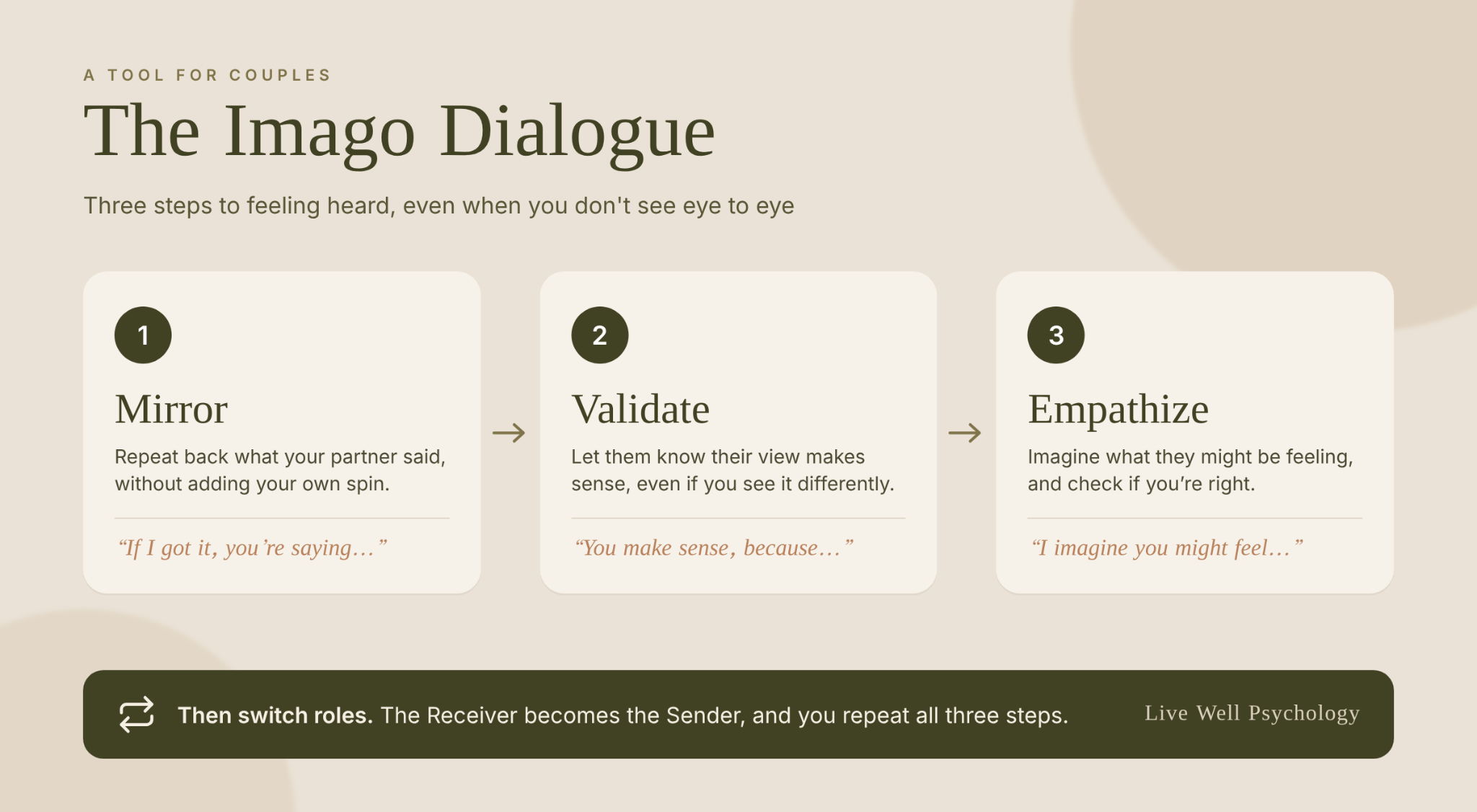
Before you start
There are two roles:
The Sender has something they want to share. They speak first.
The Receiver listens and reflects back what they hear. They hold off on sharing their own side until it's their turn.
Ask for a dialogue first. Instead of launching into a hard topic, the Sender asks something like: "I'd like to have a dialogue about something that's been on my mind. Is now a good time?"
The Receiver says yes, or picks a time. If now isn't good, name a specific time soon, like "after the kids are in bed tonight," and keep it. Saying yes when you're actually flooded or distracted doesn't help either of you.
Start small. Try your first few dialogues on something easy or positive, like something you appreciate about each other. It's much easier to learn the steps when the stakes are low.
Step 1: Mirroring
Mirroring means repeating back what your partner said, as closely as you can, without adding your own spin.
For the Sender: Speak in short chunks, a few sentences at a time. Use "I" statements about your own feelings, thoughts, and needs. When you talk about your partner, describe a specific thing they said or did, not a general judgment. "When you looked at your phone while I was talking" lands very differently than "You never listen to me."
For the Receiver: After each chunk, reflect it back and check:
"If I got it, you're saying…"
"Did I get that?"
"Is there more about that?"
Keep going until the Sender says there's nothing more. If it's too much to hold at once, it's okay to say, "Can you pause so I can make sure I'm getting it?"
Then summarize. When the Sender is done, the Receiver sums up the whole message and asks, "Did I get it all?" The Sender can fill in anything that was missed.
Mirroring is harder than it sounds. You'll notice the urge to correct, explain, or defend yourself. Notice it, set it aside for now, and keep reflecting. You'll get your turn.
Step 2: Validation
Validation means letting your partner know that their experience makes sense, from where they're standing.
Validating is not agreeing. You can see something completely differently and still understand how your partner got to their view. That's the whole point: two people can have two different, equally real experiences of the same moment.
The Receiver might say:
"You make sense. It makes sense that you'd feel that way, because…"
"I can see why that would be hard for you, given…"
Try to finish the sentence with a real reason, drawn from what your partner just told you. That's what shows them you were actually listening.
Step 3: Empathy
Empathy means imagining what your partner might be feeling, and checking whether you're right.
The Receiver names a few feelings, using single words where possible:
"I imagine you might be feeling… lonely? Frustrated? Maybe a little scared?"
"Is that what you're feeling?"
The Sender then confirms, corrects, or adds anything that was missed: "Yes, and also embarrassed."
This step is often where things soften. Most of us don't need our partner to agree with us. We need them to understand what it felt like to be us in that moment.
Switching roles
Once the Receiver has mirrored, validated, and empathized, you switch. The Receiver becomes the Sender, and the conversation goes through the same three steps from the other side.
A good way to start your turn is to share what came up for you while you were listening, like "Hearing that, I felt…" or "What I'd like to say back is…"
What it sounds like
Here's a short example of the first round:
Maya (Sender): When I came home and the dishes were still in the sink after you said you'd do them, I felt really alone. Like I'm the only one keeping track of everything.
Sam (Receiver): If I got it, when you came home and the dishes weren't done after I said I'd do them, you felt alone, like you're the only one keeping track of everything. Did I get that?
Maya: Yes.
Sam: Is there more about that?
Maya: I think I'm just tired. I want to feel like we're a team.
Sam: So you're tired, and you want to feel like we're a team. Did I get it all?
Maya: Yes, that's it.
Sam: You make sense. It makes sense you'd feel alone, because I said I'd do them and then didn't, and you've been carrying a lot. I imagine you might be feeling tired, alone, and maybe let down. Is that right?
Maya: Yeah. And a little invisible.
Notice that Sam doesn't explain why the dishes didn't get done. That can come later, on Sam's turn. Right now, the goal is for Maya to feel heard.
Tips for making it work
Practice when things are calm. Use the dialogue for appreciations and everyday topics, not just conflict. The more familiar it feels, the easier it is to reach for in a hard moment.
Take a break if you're flooded. If your heart is racing or you can't think straight, pause. Agree on a time to come back, and keep it.
Stay specific. Talk about one situation at a time, not "always" and "never."
Don't skip ahead. It's tempting to jump from mirroring straight to your own side. The steps work because they're slow.
Expect it to feel awkward. Most couples feel a little silly at first. That usually fades with practice.
When to get more support
The Imago Dialogue is a tool, not a cure-all. Consider reaching out to a couples therapist if:
The same conflict keeps coming back no matter what you try
Conversations escalate quickly, even with the structure
There's been a breach of trust, like an affair, that you're trying to repair
One or both of you feels too hurt to listen right now
This tool isn't the right fit if there is abuse or active substance use in the relationship. If you feel unsafe with your partner, please reach out for individual support. You can call the National Domestic Violence Hotline at 1-800-799-7233 or text START to 88788.
Slow down to come closer
You don't have to get it perfect. Even one round of mirroring can change the temperature of a conversation. The goal isn't to win or to agree. It's to understand each other well enough to find your way back to being on the same team.
If you'd like support practicing these skills, we offer couples therapy in person in West Los Angeles and online throughout California. Book a free consult to see if we're a good fit.
Sources
Harville Hendrix and Helen LaKelly Hunt, Getting the Love You Want